.png)
U.S. National Science Foundation Center for the Chemistry of Molecularly Optimized Networks (NSF MONET)


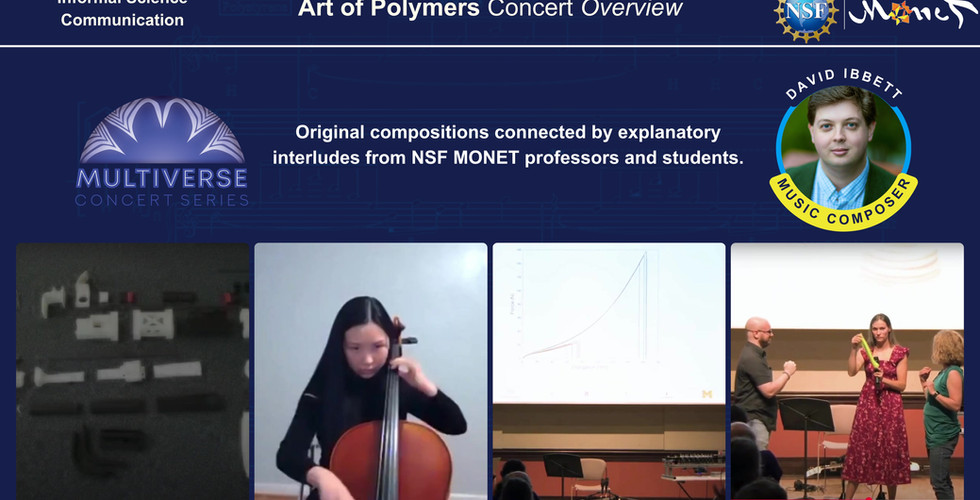








The Art of Polymers Concert Series is the flagship informal science communication initiative of the U.S. National Science Foundation Center for Molecularly Optimized Networks (NSF MONET). It converts the Center's published polymer network research into original music, animation, and live performance, and it delivers that work in concert halls, science festivals, and public media, where audiences who rarely attend a science lecture can meet the molecular world on their own terms.
Why this matters
NSF MONET's research agenda seeks molecular-level chemical control of polymer network properties, with implications for manufacturing industries that together exceed $100 billion per year. Communicating why that science matters is a stated broader impacts commitment of the Center: NSF MONET merges informal science communication with musical performances and original hands-on demonstration kits that reach audiences in a wide range of non-scientific settings.
Art of Polymers is how the Center keeps that promise. Each installment begins with a peer-reviewed NSF MONET result, pairs a Center scientist with composer David Ibbett and the Multiverse Concert Series, and ends with a public work that can travel to new venues and new audiences. Since 2021, the series and its associated media have reached more than one million people.
Documented reach, 2021 to 2026
Installment | Date | Documented outcome |
Virtual premiere of Art of Polymers | Jan 2021 | 300 live-stream attendees |
Art of Polymers live at MIT | Sep 2022 | 115 in-person attendees |
WGBH public radio feature | Sep 2022 | 100,000+ audience reach |
Advanced Science News feature | Sep 2022 | More than 50,000 average page views |
Climate HOPE Concert, with WBUR / NPR Boston broadcast | Jul 2023 | 300 tickets sold; broadcast reach of more than 800,000 |
Earthrise Concerto at the Christa McAuliffe Center, Framingham State University, closing with the Art of Polymers finale 10<sup>4</sup> Rays of Hope | Mar 2025 | Both showtimes sold out; local high school students launched a campus-wide sustainability initiative in response |
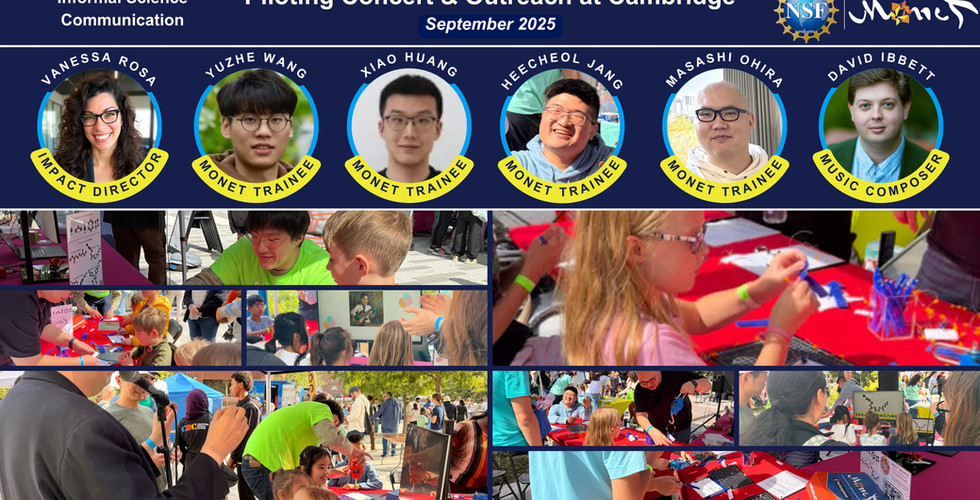
Musical Mechanophores Outreach Kit pilot, Cambridge Science Festival | Sep 2025 | Hundreds of participants engaged, primarily families |
Art of Polymers Outreach Kit 2.0 released for trainee-led use | Dec 2025 | Hands-on mechanochemistry activity packaged for reuse beyond the concert hall |
Chemistry in the Universe, Harvard Science Center | Jun 2026 | Sold out, 120 tickets; pre/post assessment of learning and audience composition |
Evidence that the approach works
The June 6, 2026 installment, Chemistry in the Universe, was designed as a direct response to reviewer feedback that science-art programming risks "preaching to the choir." NSF MONET used an astronomy-themed gateway, a 90-minute program of collaborative animation and live performance, and a closing dialogue between an NSF MONET scientist and a scientist from the Center for Astrophysics. Of the 43 attendees who completed both the pre- and post-concert survey:
58% were not scientists. 28% identified as artists and 30% identified as neither scientist nor artist.
The venue reached people who do not attend science lectures. Respondents reported high prior concert attendance (mean 77.4 on a 0 to 100 scale) but markedly lower prior science-lecture attendance (mean 50.5).
Conceptual understanding shifted measurably. Before the concert, 44% of attendees' word associations for "polymer" were everyday objects or surface-level terms such as plastics, rubber, or slime. Afterward, 98% used scientific or structural language such as chains, macromolecules, and bonds.
96% expressed a desire to learn more about chemistry.
That result is the strongest single piece of evidence in the series: a sold-out public concert produced a documented gain in how a majority non-scientist audience conceptualizes macromolecules.
Research-first, by design
Art of Polymers is not decorative. Each composition begins with a specific NSF MONET finding selected for accessibility, visual interest, and scientific impact. The 2024 to 2025 cycle built on the collaborative result from the Craig, Johnson, and Rubinstein laboratories showing that the weakest cross-linker yields the strongest network, a counterintuitive 9- to 10-fold difference in toughness (Science, 2023, 380, 1248–1252). Chemistry in the Universe extended the method further with an approximately 60-minute animation tracing the progression from the Big Bang to quarks, protons and neutrons, atoms, molecules, and finally polymers, produced collaboratively by NSF MONET, the Multiverse Concert Series, and Science with Impact.
A professional development engine for trainees
Art of Polymers doubles as a Signature Professional Development Experience (SPDE) in the Center's Outreach track. Trainees select the science, work directly with the composer, and co-deliver the public program. As of Fall 2025, NSF MONET trainees had completed more than 100 documented SPDEs, 15 of them in Outreach, against an original Phase IIa target of 26 total. The 2024 to 2025 concert development cycle alone engaged five trainees in year-long multimedia production and public science communication.
What comes next: Polymer Symphony
For Year 6 and beyond, NSF MONET is scaling the series into Polymer Symphony, a tour-ready multimedia work for museums, planetariums, schools, and online audiences. Polymer Symphony uses real NSF MONET microscopy, data visualization, and laboratory footage to make polymer research visible and emotionally legible, and it builds on the series' existing scientist and non-scientist reach while expanding annual concerts, media, and documentary storytelling. Five-year planning is underway with composer David Ibbett.