.png)
U.S. National Science Foundation Center for the Chemistry of Molecularly Optimized Networks (NSF MONET)






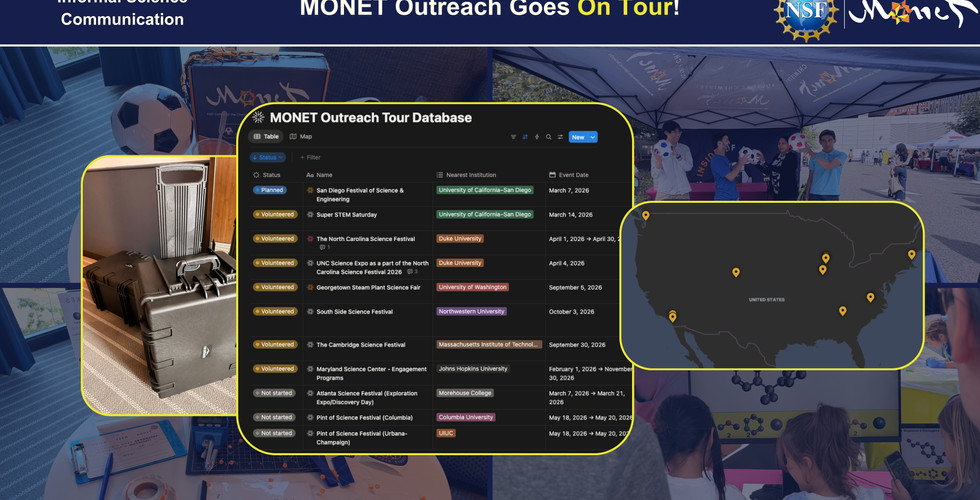




Outreach Kits are how the U.S. National Science Foundation Center for Molecularly Optimized Networks (NSF MONET) makes its research deliverable by any trainee, in any city, without a chemistry lab. Each kit packages one line of Center research into a self-contained, hands-on activity with materials, facilitator guidance, and an assessment instrument.
Why this matters
NSF MONET's central finding — that the weakest cross-linker in a polymer network can produce the strongest material — lives in molecular detail that is invisible to a non-specialist audience. Outreach that depends on individual trainees inventing their own demonstrations is neither consistent nor transferable.
The kits solve that structurally. Three activities cover a full age range, and each one is a physical object that ships:
Chemistry of Slime (ages 5–8), developed in partnership with the American Chemical Society Kids Zone
Materials Science of Soccer (ages 9–12), built around the deconstruction and materials testing of a soccer ball
Mechanophores in Action (ages 13+), developed with the Multiverse Concert Series, using color-change and sound to make bond scission perceptible
Because the kit carries the science, the facilitator does not have to. That is what lets the Center hold every participating institution to a standing commitment of two informal science communication events per year, and what lets an activity built at one institution run unchanged at another.
Documented reach
Deployment | Period | Documented result |
Version 2.0 kits distributed to NSF MONET labs | 2026 | Three kits shipped to 13 Center labs, so every participating institution holds the full set |
Kits requested by and shipped to external institutions | May 2024 – Mar 2025 | 13 recipient institutions across three continents, spanning research universities, undergraduate-focused colleges, an industry partner, a community organization, and a homeschool educator |
Cambridge Science Festival at MIT, pilot of both revised kits | Sept 2025 | 500+ festival attendees; seven trainee and partner volunteers |
Mechanophores Kit 2.0 field use | 2025–2026 | 600+ learners reached across schools, museums, and community centers |
Squishy Science Sunday, Denver Museum of Nature & Science | Mar 2026 | ~200 museum visitors engaged with the Materials Science of Soccer kit |
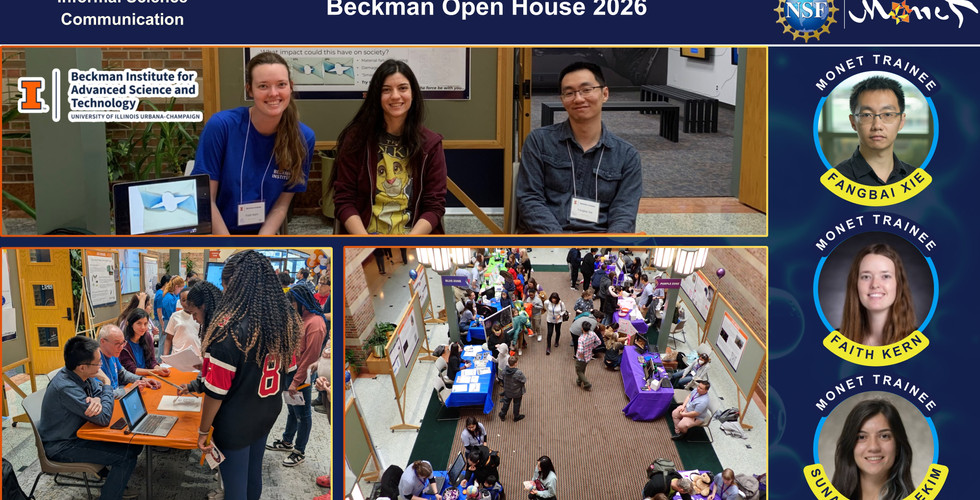
Beckman Open House | Apr 2026 | 1,000 attendees |
Program-wide activity enabled by the kits | Jan 2024 – Aug 2026 | 30+ events and 5,000+ participants recorded by the Center's outreach program |
The external recipient list includes Louisiana State University, the Georgia Institute of Technology, Boston Scientific, Seattle Pacific University, Université Catholique de Louvain in Belgium, the United Moroccan American Association of Cleveland, Williams College, Monmouth College, Trinity Washington University, Marshall University, and the California State University Chancellor's Office.
Evidence that the kits work
Measured learning gains, not attendance alone
The Mechanophores Kit 2.0 was evaluated with pre- and post-activity instruments rather than headcounts. At the American Chemical Society Kids Zone, participants showed a 50.9% increase in their ability to describe a chemical mechanism. Across surveyed participants, 84% rated the activities moderately to highly engaging, and 80% of Chicago participants reported increased interest in science. The evidence base for these figures is itself documented: 38 activity feedback responses, 30 participant surveys, and 90 assessment index cards.
Field feedback drives documented revisions
The Materials Science of Soccer 2.0 redesign is a traceable response to specific criticism gathered between 2022 and 2025. Participants had been getting inconsistent contact-angle results because the protractor was too large for a water droplet; the measurement was replaced with a binary wettability observation. Facilitators reported that printed instructions were missing from kits; the revision ships a step-by-step facilitator guide with timing markers, quantities, and preparation protocols. Trainees reported that instructions were too vague; the revision specifies participant directions and questioning sequences verbatim.
The same loop continues. At Squishy Science Sunday 2026, the trainee facilitator's assignment was explicitly to collect field observations on facilitation and clarity before the kit scales further.
Assessment capability built into the activity
The 2.0 revision added an index-card pre/post instrument with the same core question on both sides, a five-level rubric running from surface description to transfer of understanding, and draw-or-write response options. This is what converts an outreach event from an attendance figure into a measurable learning outcome, and it is why the gain figures above exist at all.
Range of documented venues
Recorded deployments span a public library system in Baltimore County, an elementary school science night in La Jolla with three hands-on stations, a middle school science fair booth in Seattle, museum floors at the Fleet Science Center and the Denver Museum of Nature & Science, university open houses, and American Chemical Society Kids Zone installations in San Diego, New Orleans, Atlanta, and Chicago. Summer kits delivered to Chicago elementary students were run bilingually.
What comes next
Documented next steps are the distribution of the revised 2.0 kits following the Cambridge pilot, a slime video game under development that teaches polymer chemistry through computational chemistry simulations, and a recommended standing feedback mechanism so participant and facilitator input is collected continuously rather than per event.